
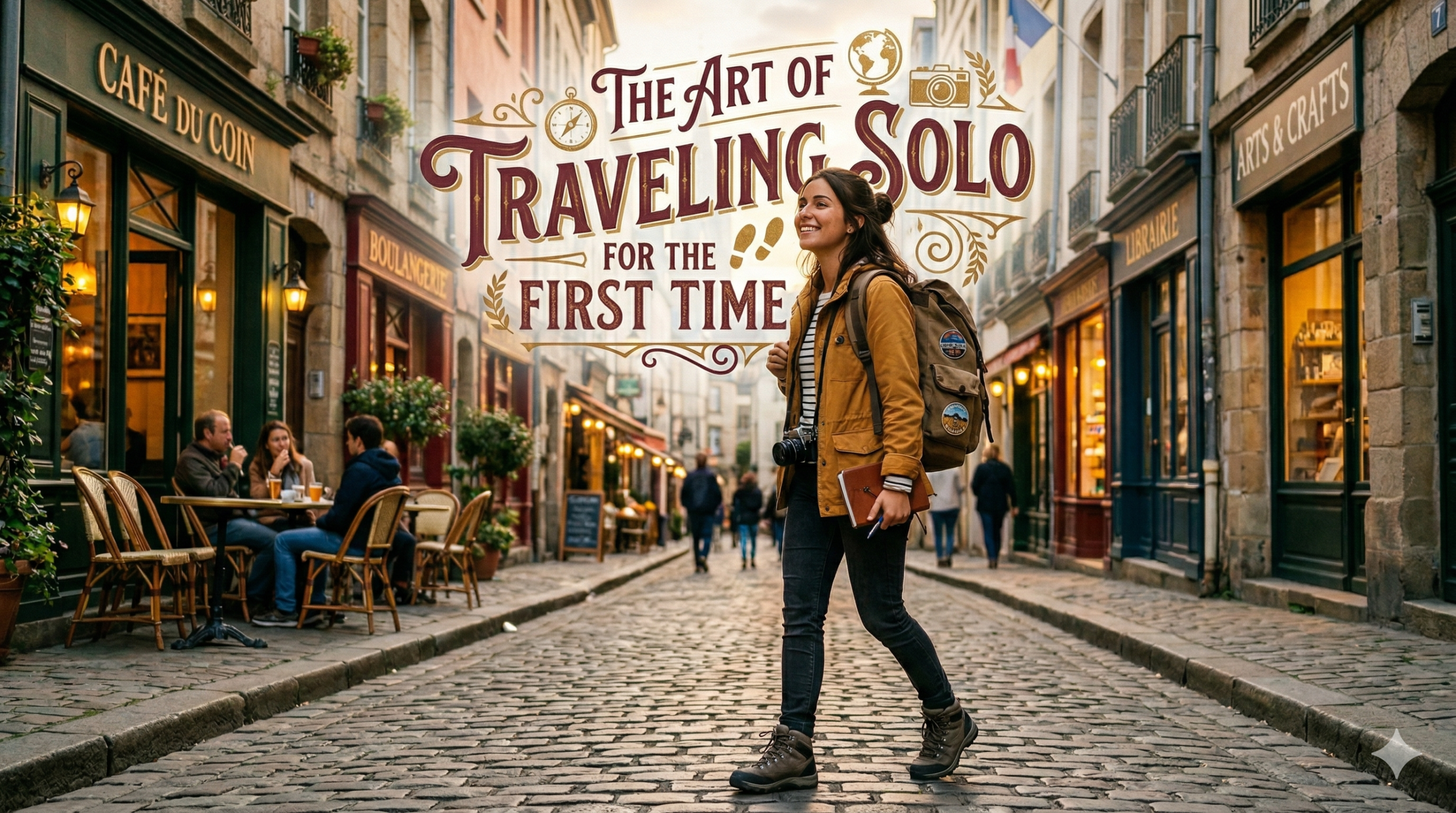
There’s a specific kind of terror that greets you the night before your first solo trip. You’ve booked the flights, packed the bag, and set three alarms — but somewhere between double-checking your travel insurance and re-reading the hostel reviews, a voice whispers: What if this was a terrible idea?
That voice is wrong. Or at least, it’s only telling you part of the story. The other part — the part no one warns you about — is that solo travel will become one of the most quietly transformative things you’ll ever do. Not because everything goes perfectly. In fact, largely because it doesn’t.
This is a guide for the nervous first-timer. For the person who has fantasized about solo travel for years but can’t quite push past the fear. We’ll talk honestly about the fears (all of them), the hard lessons, the surprising joys — and why, despite everything, you absolutely should go.
Part One: The Fears Are Real (But They’re Lying to You)
Let’s not pretend the fears aren’t there. That kind of toxic positivity helps no one. Here are the most common fears first-time solo travelers carry — and what the reality actually looks like.
- 01
“I’ll be lonely the whole time.”This is the big one. The image of eating dinner alone in a strange city, watching couples laugh nearby, feels unbearable before you go. Reality: solo travelers are, paradoxically, the least lonely people on the road. When you’re alone, you’re approachable. Locals talk to you. Other travelers pull up a chair. You end up having deeper, more spontaneous conversations in a single week than in months at home.
- 02
“Something bad will happen to me.”The fear of danger is real, but it’s often inflated by distance. Somewhere new feels riskier than somewhere familiar — even when the statistics say otherwise. Basic awareness, decent research, and trusting your instincts go an enormous way. Most seasoned solo travelers look back and realize the danger they imagined never materialized; the real risks were small, manageable, and nothing like the movie version in their head.
- 03
“I’m not the type of person who does this.”There is no type. Solo travelers are introverts and extroverts, seasoned adventurers and nervous first-timers, 22-year-olds and 67-year-olds. The idea that you need a certain personality, a certain physique, or a certain past to travel alone is fiction. Boldness is a skill, not a trait — and the first solo trip is where you begin to build it.
- 04
“I’ll make every decision wrong.”You’ll make some decisions wrong. You’ll take the wrong bus, book the wrong neighborhood, misread the menu, miss the last train. And you’ll survive every single one of them. The gift of mistakes made alone is that you handle them alone — and discover that you’re capable of far more than you thought.
“Solo travel doesn’t require you to be fearless. It only requires you to be slightly more curious than afraid.”
Part Two: The Lessons Nobody Talks About
There are things you’ll read in every travel guide: bring copies of your passport, get travel insurance, learn a few words of the local language. All true, all useful. But there’s another category of lesson — the kind that arrives quietly, usually in the middle of something that’s going mildly wrong, and changes you in ways you can’t quite explain afterward.
You discover what you actually like
Without the negotiations of group travel — where do you want to eat, what do you want to see, how long do you want to stay — you’re suddenly face to face with your own preferences. And sometimes they’re surprising. You might discover you’d rather spend three hours in a single museum hall than race through a highlights tour. That you prefer the quiet square to the famous plaza. That you’re a morning person, or that you’re not. Solo travel is a peculiarly honest mirror.
Boredom is underrated
Modern life is chronically overscheduled. Solo travel — especially if you resist the urge to fill every hour — gives you something increasingly rare: unstructured time. The afternoon you have nothing planned is often the one where something unexpected happens. You follow a sound down a side street. You end up in a conversation with a baker, a retired professor, a fellow traveler with a better story than anything in the guidebook. The best travel moments are rarely the scheduled ones.
You become a better problem-solver
When a flight is cancelled and you’re alone in an airport in a country where you don’t speak the language, there is no one to turn to. You have to figure it out. You ask, you improvise, you find out what you’re capable of. It sounds dramatic, but it doesn’t have to be — even small logistical challenges handled solo have a cumulative effect. By the end of the trip, you trust yourself more. It’s not arrogance; it’s earned confidence.
“The afternoon you have nothing planned is often the one where something extraordinary happens.”
People are almost always kind
This is the lesson that most surprises first-time solo travelers, and it’s the one that stays longest. The stranger who notices you’re lost and walks you to your destination. The café owner who explains the whole menu in broken English and brings you something extra. The fellow traveler who invites you to join their dinner plans. Human kindness is everywhere once you stop being too guarded to see it — and solo travel lowers your guard in a way that group travel never quite does.
Part Three: Practical Things That Actually Help
Beyond the philosophy, here are the practical strategies that make solo travel smoother, safer, and more enjoyable — especially the first time around.
Part Four: Why You Should Do It Anyway
Here’s the thing about solo travel: it forces a confrontation with yourself that comfortable life expertly avoids. At home, you’re surrounded by context — your role, your relationships, your routines. Strip all of that away and drop yourself in a new place, and a question emerges, quietly at first: Who am I when no one here knows me?
Most people find the answer more interesting than they expected. They’re funnier, more resourceful, more adaptable. They’re braver in small moments and more patient in big ones. They start conversations they’d never start at home. They get lost and don’t panic. They sit alone at a table for eight and feel, to their own astonishment, perfectly fine.
Solo travel also recalibrates your relationship with uncertainty. In everyday life, uncertainty is something to be managed, minimized, controlled. On the road alone, uncertainty is just the texture of Tuesday. The bus might not come. The café might be closed. The hostel might be nothing like the photos. You adapt, you pivot, you find something better. This skill — this tolerance for the unplanned — doesn’t stay in the suitcase when you get home. It travels back with you.
“Who am I when no one here knows me? Most people find the answer more interesting than expected.”
And then there’s the simplest reason of all: you get to do exactly what you want, at exactly the pace you want, for as long as you want. You can spend four hours in a gallery and not feel guilty. You can change your plans entirely because someone told you about a village two hours away. You can eat dinner at 5pm or midnight. You can take the scenic route, or the wrong route, and count them both as success.
No compromise. No negotiation. Just you and the world, working things out together.
One Last Thing Before You Go
You don’t need to feel ready. Readiness, for most first-time solo travelers, is something you feel in hindsight, looking back from the other side. Before the trip, there’s just the decision.
Start small if you need to. A long weekend, a neighboring city, somewhere close enough that you can get home quickly if everything falls apart (it won’t). Prove to yourself that you can navigate an unfamiliar place alone. Then go a little further. Then further still.
The fears don’t completely disappear — they just stop running the show. And in their place, something quieter and more useful grows: the knowledge that you are, in fact, the kind of person who does this. Who figures things out. Who shows up alone in a strange place and makes something of it.
That knowledge is yours to keep. No one can take it back through customs.